BurnerByte Documentation
Install BurnerByte with Docker Compose, set up MX and TXT records, harden it for production, and call the REST API — 162 operations across 122 paths.
Which version this describes
Checked against v1.24.0 on 2026-09-18. If you are running something newer, the release notes are the authority on what changed since.
Welcome to BurnerByte
BurnerByte is a self-hosted temporary email platform built for teams that need disposable email addresses for testing, development, and QA workflows. It provides real-time email delivery, configurable attachment policies, webhooks, a full RBAC system, and SSO integration — all running on your own infrastructure.
BurnerByte is open-source under the Apache 2.0 license. Source code is available on GitHub.
Get Started
Core Concepts
Architecture
Deploy & Operate
API & Frontend
A Look Around
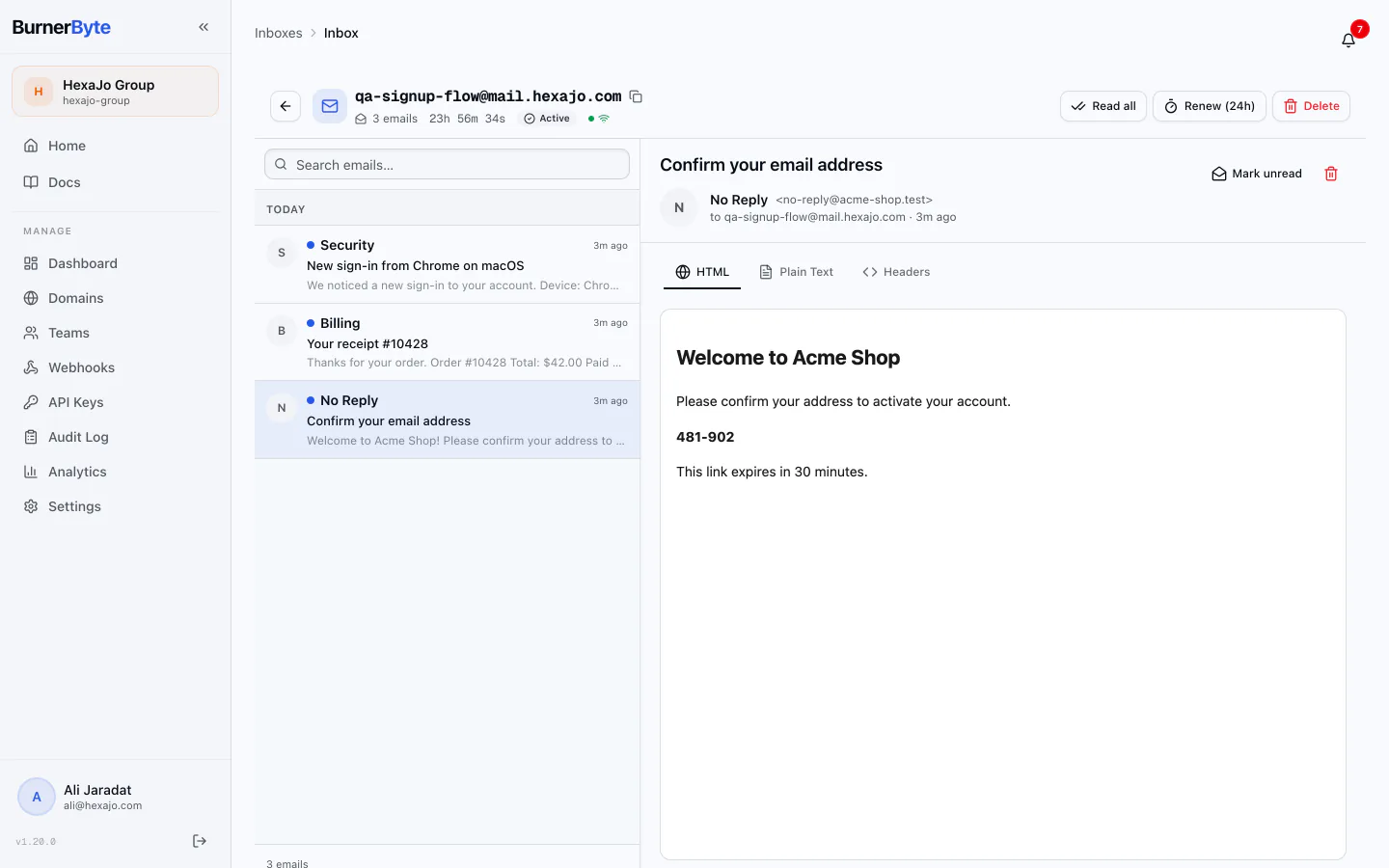
Every screen of a running instance — inbox creation, live mail, the reader, dashboard, analytics, domains, teams, the audit log and settings — is in the screenshot gallery, full size, with detail on each.
Architecture at a Glance
┌─────────────────┐ Next.js UI ────────▶ │ Go API │ ───▶ PostgreSQL (:3000) │ (:8080) │ ───▶ Redis (pub/sub) │ Chi + Workers │ ───▶ MinIO (attachments) └─────────────────┘ ▲ │ subscribes: live email + notifications │ External MTAs ─────▶ ┌─────────────────┐ (inbound SMTP) │ Go SMTPD │ ──▶ parses + stores, │ (:2525) │ publishes to Redis └─────────────────┘ Two independent Go binaries: cmd/smtpd receives mail and publishes to Redispub/sub; cmd/api persists it, fans out over WebSocket, and serves the UI/API.Two separate Go binaries, which scale differently:
cmd/api— HTTP API server + background workers. Run exactly one: every replica starts all seven workers and there is no leader election, so a second one duplicates every job.cmd/smtpd— SMTP inbound server. Scales out freely.
See Architecture Overview for what that ceiling costs and Background Workers for the jobs involved.
Key Features
| Feature | Description |
|---|---|
| Setup Wizard | Guided first-run setup: admin account, org, SMTP, domain, team, branding, invites |
| Multi-team | Single org with teams scoped to specific domains |
| Full RBAC | 5 roles across org and team levels, DB-backed permissions |
| Real-time | WebSocket streaming for instant email and notification delivery |
| Attachments | Configurable policies inherited across org, domain and assignment |
| Webhooks | HMAC-SHA256 signed with exponential backoff retry |
| API Keys | Scoped programmatic access with SHA-256 hashing and IP allowlists |
| Audit Log | Full activity trail with filtering, search, and CSV export |
| Analytics | Time-series charts, peak hours, domain breakdown, top senders |
| SSO | Multi-provider OIDC with auto-provisioning, domain mappings, claim mappings |
| Private Inboxes | Only the creator can access their inboxes and emails |
| Bulk Operations | Bulk invite, bulk verify, bulk delete, bulk revoke |
Tech Stack
| Layer | Technology |
|---|---|
| Backend | Go 1.25+, Chi router, pgxpool, go-redis, gorilla/websocket, enmime |
| Frontend | Next.js 16, React 19, shadcn/ui, Tailwind CSS 4, Zustand, TanStack Query, Recharts |
| Docs | MDX, published at burnerbyte.com/docs |
| Database | PostgreSQL 16 (50 migrations, 74 indexes, 8 triggers) |
| Cache | Redis 7 (inbox routing, analytics cache, rate limiting) |
| Storage | MinIO or any S3-compatible store for attachments, with a local-filesystem fallback |
| Infrastructure | Docker, Docker Compose |
| CI | GitHub Actions (.github/workflows/ci.yml) — Go tests against live Postgres and Redis, frontend lint/typecheck/test/build, and a full docker compose build |
| Testing | pgregory.net/rapid for property-based testing |